By Axiom 360— Creative Marketing Agency, UK
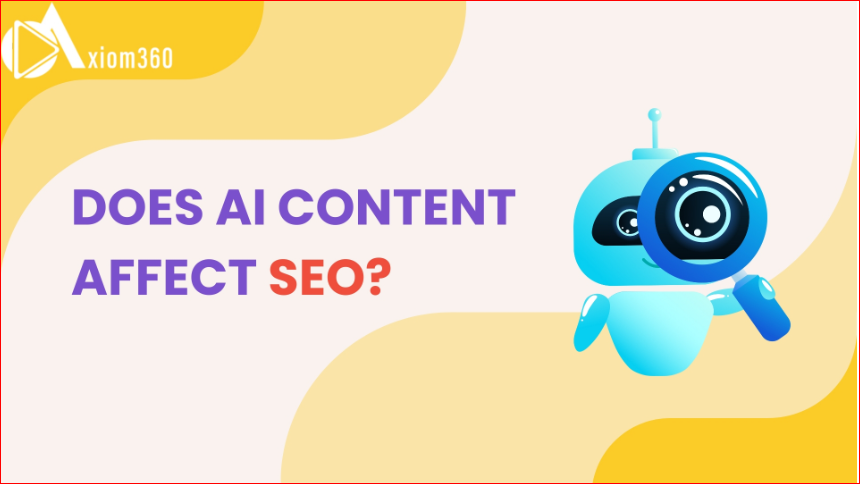
The question has been bouncing around every marketing Slack channel, LinkedIn thread, and agency boardroom since ChatGPT went mainstream: Is AI content bad for SEO? If we use AI to write our content, will Google punish us? The short answer is more nuanced than a simple yes or no — and understanding the real answer could be the difference between your content ranking on page one or disappearing into the void. At Axiom 360, a creative marketing agency in the UK, we work with businesses daily who are wrestling with exactly this question.
First, Let’s Get Google’s Stance Straight
One of the most searched questions in digital marketing right now is: Does Google penalise AI content? Google has been refreshingly direct on this issue, which is unusual for a company that typically guards its algorithmic logic like a state secret. In February 2023, Google’s Search Central team confirmed that AI-generated content is not automatically penalised. What Google penalises is content that violates its core quality standards — regardless of who (or what) wrote it.
Their Search Essentials documentation puts it plainly: the focus is on whether content demonstrates Experience, Expertise, Authoritativeness, and Trustworthiness — the E-E-A-T framework. A robot can technically produce words. A robot cannot, at least not yet, replicate genuine first-hand experience or demonstrate real-world authority.
Google’s Official Position: “Our focus on the quality of content, rather than how content is produced, is a more durable focus that helps people continue to find helpful information over time.” — Google Search Central Blog, 2023
So the question isn’t just “is AI content bad for SEO?” The more precise question is: “Does AI content rank — and is yours good enough to get there?” That’s where things get complicated.
The Real Risks of Raw AI Content
Let’s be honest about what the market is flooded with right now. The accessibility of AI writing tools has produced an avalanche of low-quality, templated, hallucination-prone content. Marketers are betting that sheer volume of AI content for SEO will move the needle — publishing at scale and hoping for the best. Here’s why that strategy is collapsing, and why AI-generated SEO content without proper editorial oversight is a liability:
1. Thin Content Still Gets Crushed
Google’s Helpful Content System — updated repeatedly through 2023 and 2024 — is specifically designed to demote content that exists to rank, not to inform. AI, when prompted poorly, is extraordinarily good at producing this kind of filler. Endless word counts. Repetitive phrasing. Generic advice that adds zero value to a reader who came with a real question.
2. The E-E-A-T Gap
The first “E” in E-E-A-T stands for Experience — added by Google in December 2022 as a direct signal that they value content authored by people who’ve actually done the thing they’re writing about. AI has been trained on text; it hasn’t run a SaaS company, treated a patient, or filed a tax return. For YMYL (Your Money or Your Life) topics like health, finance, and legal advice, this gap is enormous — and Google’s quality raters are explicitly trained to look for evidence of real-world experience.
3. Factual Hallucination Risk
AI language models hallucinate. They invent statistics, misattribute quotes, and confuse dates. Publishing unreviewed AI content means you might be putting false information on your site — damaging your credibility with readers and potentially triggering a manual review if the inaccuracies are flagged.
4. Duplicate and Near-Duplicate Content
Because AI models draw from the same training data, content on similar topics often shares a suspicious structural resemblance — even across different websites. Google’s systems are increasingly sophisticated at detecting patterns that suggest templated mass production, which at scale can trigger site-wide devaluation.
- Generic content with no differentiated angle or original insight
- Statistics and quotes that haven’t been fact-checked against primary sources
- No author bio, credentials, or byline — an E-E-A-T red flag
- Keyword stuffing that reads naturally to a machine but not to a human
- No internal linking strategy or topical authority architecture
- Zero backlinks because no one actually wants to cite generic filler
Google doesn’t care if a human or a machine wrote your content. It cares whether a real person found it useful.
Does AI Content Rank? When It Actually Works for SEO

Here’s what the critics of AI content for SEO consistently miss: used correctly, AI is one of the most powerful content-production tools the SEO industry has ever had access to. Does AI content rank? Yes, but only when you understand where AI adds velocity and where human intelligence is non-negotiable. The teams winning at organic search right now aren’t avoiding AI; they’re deploying it with discipline.
The Smart Hybrid Model
The highest-performing content teams in 2026 aren’t choosing between AI and human writers. They’re combining both in a structured workflow that looks something like this:
| Stage | Who Does It Best |
| Keyword & search intent research | AI-Assisted — fast cluster mapping and SERP analysis |
| Content outline & structure | AI-Drafted — covers heading logic and content gaps quickly |
| First draft body copy | AI-Drafted — efficient for factual, instructional content |
| E-E-A-T signals (experience, opinion) | Human Only — personal insight, case studies, real examples |
| Fact-checking & source citation | Human Only — AI hallucinations must be verified manually |
| Tone, brand voice & editing | Human Only — AI is generic; brand voice is a differentiator |
| Internal linking & on-page SEO | AI-Assisted — pattern matching for linking opportunities |
| Promotion & outreach strategy | Human Only — relationship-driven, context-dependent |
Teams that follow this model are consistently publishing content faster, at a lower cost, while maintaining — and in many cases improving — their organic rankings. The AI handles the scaffolding; the human builds the house.
Use Cases Where AI Content Genuinely Thrives
Programmatic SEO
Product descriptions, location pages, comparison tables — templated content at scale where AI consistency is a feature, not a bug.
FAQ & Schema Content
AI excels at generating well-structured Q&A content that targets featured snippets and voice search queries.
Meta Descriptions & Titles
Batch generating, A/B testing, and optimising metadata across hundreds of pages — AI does this in minutes.
Content Refreshes
Updating outdated stats, expanding thin sections, and reformatting legacy posts for featured snippet eligibility.
What About AI Detectors — Should You Worry?
This is where a lot of content marketers lose sleep unnecessarily. As of 2026, Google does not use AI detection tools to penalise content. The company has been explicit: they look at the quality and helpfulness of the output, not the means of production.
Commercial AI detectors (GPTZero, Copyleaks, etc.) are notoriously unreliable — they routinely flag human-written content as AI-generated, and vice versa. Basing your editorial strategy around passing an AI detector is misguided because it optimises for the wrong thing. Optimise for human readers and Google’s quality signals instead. The detector scores will follow.
Axiom360 Verdict
Don’t optimise to fool AI detectors. Optimise to genuinely help your reader. If your content does the latter, the detector scores (and your rankings) will take care of themselves.
The Helpful Content System: What It Actually Targets
Google’s Helpful Content System (HCS) is the primary algorithmic mechanism most likely to affect AI-generated SEO strategies. It’s worth understanding precisely what it targets, because it’s not a detector for AI writing — it’s a detector for unhelpful writing. At Axiom 360 UK, we’ve audited dozens of sites hit by HCS updates, and the pattern is consistent: it’s not the AI that caused the damage, it’s the absence of genuine editorial value.
The HCS asks questions like: Was this content written primarily for search engines rather than people? Does the site have a clear purpose, or does it publish on every conceivable topic? Would a reader feel satisfied after reading this, or feel the need to search again?
If your AI-generated content answers those questions well, the HCS is not your enemy. The websites that got crushed by HCS updates were predominantly those publishing thin, mass-produced content with no topical focus — something that was a problem long before AI made it easier to produce at scale.
- Write for a clearly defined audience with a specific need, not a broad keyword
- Add genuine first-hand perspective, data, or case studies that AI cannot replicate
- Build topical authority by covering a subject deeply, not widely
- Every page should fully satisfy the search intent — not tease a paywall or leave gaps
- Link to authoritative external sources; demonstrate that your team has done research
- Include a credible author bio with verifiable expertise where relevant
- Maintain a consistent publishing schedule that signals editorial investment
The Future: Where AI and SEO Are Heading Together
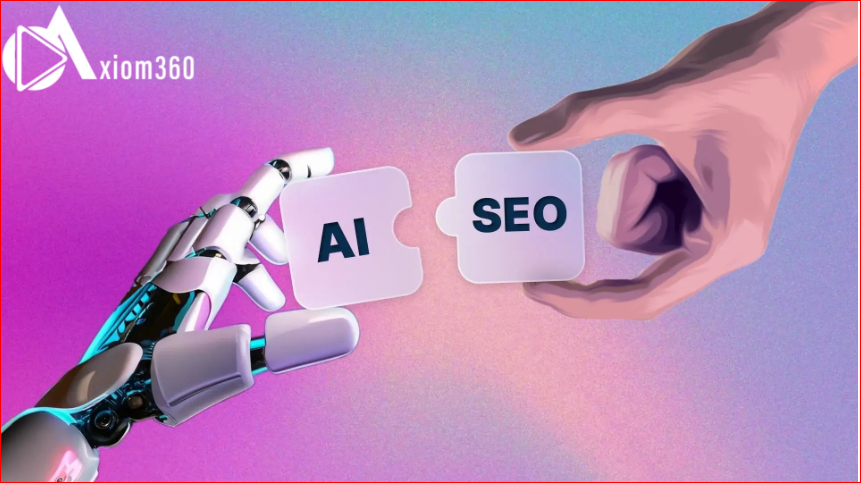
It would be intellectually dishonest to write this piece without acknowledging that the landscape is shifting faster than any content strategy can fully account for. Google’s AI Overviews (formerly SGE) are already pulling answers directly into the SERP, reducing click-through rates for informational queries. Simultaneously, Perplexity, Claude, and ChatGPT are becoming genuine research tools that bypass traditional search entirely for millions of users.
In this environment, the content that wins isn’t just content that ranks — it’s content that gets cited. The new metric isn’t just page-one position; it’s whether AI systems, journalists, and researchers reference your content as a source. That requires the kind of original research, proprietary data, and expert insight that no AI can generate on its own.
The brands that will dominate the next five years of organic search are those building content operations where AI accelerates production while human expertise drives differentiation. That’s not a compromise — it’s a superpower. It’s the model we’ve built at Axiom 360, and it’s what separates a creative marketing agency that delivers results from one that simply delivers content.
The next frontier isn’t ranking on Google. It’s being cited by AI — and only original expertise earns that.
Real-World Case Studies: AI Content & SEO in Action
Theory is useful. Real results are better. Here are three documented examples — spanning different industries and strategies — that show exactly how AI content for SEO performs when deployed with discipline versus when it’s left to run unchecked.
Case Study 1: E-Commerce Brand — Programmatic AI Pages at Scale
Retail · UK Market · 2024
A mid-sized UK e-commerce retailer with over 4,000 product SKUs needed to rank for long-tail, high-intent search queries without the budget to hire a team of copywriters. They deployed an AI content workflow to generate product descriptions, category page introductions, and FAQ sections — each template reviewed by a single editor before publishing.
What they did right: Every AI-generated page was built around a specific search intent cluster, included verified product specifications, and linked internally to related category pages. Author review ensured factual accuracy and brand voice consistency.
Results after 6 months:
- +218% Organic Traffic
- 1,400+ New Keywords Ranked
- 3.2× Revenue from SEO
Key takeaway: AI-generated content at scale works when each page serves a genuine user need and is validated by a human before it goes live.
Case Study 2: Content Farm — What Happens When You Skip the Human Layer
Publishing · News & Lifestyle · 2023–2024
A digital publishing group launched a network of niche lifestyle blogs using fully automated AI-generated SEO content — no editorial review, no fact-checking, no expert involvement. They published 300–500 articles per month per site, targeting high-volume keywords with templated AI output.
What went wrong: Initially, several sites saw ranking gains as Google’s crawlers indexed the content. But after the March 2024 core update — which specifically targeted “scaled content abuse” — the network lost an average of 76% of its organic traffic within 60 days. Several sites were effectively deindexed.
Results:
- 📉 −76% Traffic Lost
- ⏱ 60 Days to Full Collapse
- ❌ 3 Sites Deindexed
Key takeaway: Does Google penalise AI content?
Not for being AI — but absolutely for being unhelpful, low-quality, and mass-produced without editorial oversight. This is precisely the outcome Google’s Helpful Content System was designed to produce.
So, Is AI Content Bad For SEO?
Here’s the definitive answer, after all the nuance: No, but it’s very easy to make it bad for SEO. The distinction matters enormously, and it’s one that Axiom 360 UK has been helping clients navigate since AI content tools entered the mainstream.
Raw, unreviewed, generic AI-generated SEO content published at an industrial scale with no editorial oversight is absolutely bad for SEO. It was bad content before AI made it easy to produce, and it’s bad content now. The tool didn’t create the problem; it amplified it. And to answer the question squarely — does Google penalise AI content? Not the AI itself. But it absolutely penalises the low-quality output that AI too often produces when left unsupervised.
But AI content for SEO that’s been properly prompted, fact-checked, enriched with genuine expert perspective, structured for search intent, and published as part of a coherent topical authority strategy? Does AI content rank when built that way? Consistently — yes. It competes and often wins against content written by a human alone.
The question you should be asking isn’t about the technology. It’s about the editorial standards behind it.
The Bottom Line
AI is a force multiplier for content teams with strong SEO foundations. It’s a liability for teams without them. The technology is neutral — your process determines whether it lifts or sinks your rankings.
Need a Content Strategy That Actually Ranks?
Axiom 360 is a creative marketing agency based in the UK, helping businesses build AI-assisted content programmes that drive real organic growth — without the shortcuts that kill long-term rankings. Whether you’re asking Is AI content bad for SEO, ” Does AI content rank, or need a full AI-generated SEO audit, our team is ready to help.
Book a Free SEO Consultation now →
Commonly Asked Questions
Q: Is AI content bad for SEO in 2026?
No — not if it’s reviewed, fact-checked, and written to help real people. The problem isn’t AI; it’s lazy, unedited output published purely to rank.
Q: Does Google penalise AI content?
Not automatically. Google penalises low-quality, unhelpful content — regardless of who wrote it. AI just makes it easier to produce bad content at scale.
Q: Does AI content rank on Google?
Yes — when it meets Google’s quality standards. Thousands of pages using AI-assisted workflows are ranking on page one right now. Quality is the only filter that matters.
Q: What is the best way to use AI content for SEO?
Use AI for speed — drafts, outlines, metadata. Use humans for accuracy, expert insight, and brand voice. That hybrid approach is what consistently wins rankings.
Q: Will AI content detectors hurt my SEO rankings?
No. Google doesn’t use AI detectors in its ranking systems. Stop optimising to pass a detector and start optimising to genuinely help your reader.
Q: How does AI generated SEO content affect E-E-A-T?
Negatively, if used alone. AI has no real experience. Add author bios, first-hand insight, and original data on top of AI drafts to satisfy Google’s E-E-A-T requirements.
Q: How can Axiom 360 help with my AI content strategy?
Axiom 360 builds content strategies that combine AI efficiency with expert editorial oversight. Get in touch at axiom360.co.uk/contacts — we’ll audit your content and build a plan that actually ranks.
About the Author
Sana Riaz is a seasoned SEO content strategist with over five years of experience in writing for the SaaS industry and creating technical content that resonates with both search engines and readers. Her expertise spans various aspects of SEO, including AEO, GEO, schema optimization, and the integration of AI in content strategies. Sana specializes in developing high-quality, AI-ready content that is not only optimized for search engines but also crafted to meet the demands of the evolving digital landscape. When she’s not diving into SEO trends, you can find her exploring new AI tools and strategies to stay ahead in the competitive world of digital marketing.
Feel free to connect with Sana on LinkedIn for more insights into SEO, content strategy, and AI-driven marketing trends.