Let me tell you something that most marketing blogs won’t admit: content without a funnel is just noise.
You can publish a blog post every day. You can go viral on LinkedIn. You can rank on page one of Google. But if your content isn’t designed to guide a person from “I’ve never heard of you” to “take my money,” — you’re leaving an enormous amount of value on the table.
That’s exactly what the content marketing funnel is designed to fix. At Axiom360, we’ve helped brands across the UK turn scattered content into structured, high-converting funnel systems — and in this guide, we’re going to show you exactly how it works. We’ll walk you through everything — what a content marketing funnel is, how each stage works, a real-world example, how the SaaS model differs, and what’s changed heading into 2026.
Whether you’re a startup founder, a B2B marketer, or an agency looking to sharpen your strategy, this is the most complete breakdown of the content marketing funnel you’ll find today.”
What Is a Content Marketing Funnel?
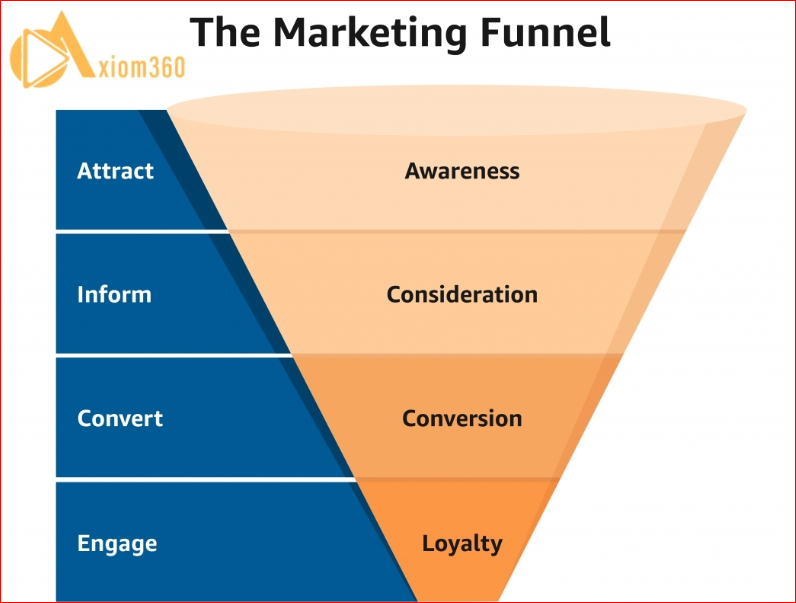
At its core, a content marketing funnel is a strategic framework that maps specific pieces of content to specific stages of the buyer’s journey. The idea is simple: different people need different information at different points in their decision-making process. The funnel gives you a structured way to deliver the right content to the right person at exactly the right time.
Think of it like a physical funnel — wide at the top, narrow at the bottom. At the top, you’re casting a broad net to attract as many relevant potential customers as possible. As they move down, they get progressively more interested, more informed, and more ready to buy. Your content accelerates that journey at every step.
Key insight: “A content marketing funnel isn’t about manufacturing a journey — it’s about meeting people where they already are and giving them a reason to keep moving forward.”
The concept builds on the traditional AIDA model (Awareness, Interest, Desire, Action) but has evolved significantly for digital marketing. Today, the content marketing funnel often extends beyond the sale to include retention, advocacy, and community — especially in SaaS and subscription businesses.
Industry insight: Businesses with a documented content strategy and funnel alignment are over 4x more likely to report strong content marketing success than those without one.
Why the Content Marketing Funnel Still Matters in 2026
Every few years, someone declares that some aspect of digital marketing is “dead.” The funnel gets its fair share of these eulogies. But the mechanics of human decision-making haven’t changed. People still move through stages of awareness, consideration, and decision. What’s changed is the environment they move through.
In 2026, the content landscape is noisier than ever. AI-generated content is everywhere. Attention spans are fractured across dozens of platforms. Zero-click search results mean Google often answers questions before users reach your website. In this environment, a well-built content marketing funnel isn’t just useful — it’s a competitive survival tool.
Here’s why it matters more than ever:
- Personalisation at scale: A funnel lets you serve contextually relevant content based on where someone is in their journey, without manually segmenting every interaction.
- Compound SEO value: Funnel-aligned content creates topical authority clusters that help your entire site rank — not just individual posts.
- Better attribution: When content is mapped to funnel stages, it becomes far easier to understand which content is driving which business outcomes.
- Reduced sales cycles: When prospects arrive at a sales conversation having already consumed your MOFU and BOFU content, they’re informed, pre-qualified, and faster to close.
Content Marketing Funnel Stages Explained
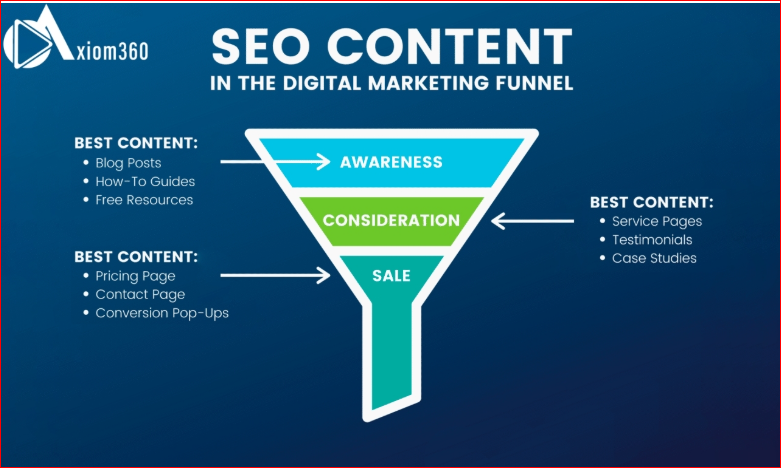
The standard model divides the funnel into three broad zones: Top of Funnel (TOFU), Middle of Funnel (MOFU), and Bottom of Funnel (BOFU). Many modern frameworks add a fourth post-purchase stage. Here’s each one in detail.
Stage 01: Top of Funnel (TOFU) — Awareness
This is where strangers become visitors. Your audience at this stage doesn’t know your brand, your product, or even sometimes that a solution to their problem exists. Your job isn’t to sell — it’s to educate, entertain, and earn their attention.
TOFU content targets broad, informational search queries. The KPIs here are reach, impressions, organic traffic, and social engagement — not conversions.
Content types: SEO blog posts, how-to guides, short-form video, infographics, podcasts, social content, and thought leadership articles.
Stage 02: Middle of Funnel (MOFU) — Consideration
The middle of the funnel is where the real relationship-building happens. Your audience knows they have a problem, and they’re evaluating options. Your content needs to position your solution as the most credible, most capable choice.
MOFU content tends to be more in-depth and often gated (requiring an email address). Many marketers skip this stage entirely, going straight from TOFU blogs to BOFU sales pages — leaving a huge gap in the middle.
Content types: Long-form guides, comparison posts, case studies, email sequences, webinars, free tools and templates, whitepapers.
Stage 03: Bottom of Funnel (BOFU) — Decision
This is where intent becomes action. BOFU content speaks directly to prospects who are ready to buy. They’re comparing you against competitors, checking your pricing, and looking for social proof.
The content here is highly conversion-focused with strong calls-to-action. Be direct, be compelling, and make the path to purchase frictionless.
Content types: Product/service pages, customer reviews, demo videos, ROI calculators, free trials, pricing pages, proposals and audits.
Stage 04: Post-Purchase — Retention & Advocacy
The modern content marketing funnel doesn’t end at conversion. Retaining a customer costs significantly less than acquiring a new one, and a happy customer who advocates for your brand is worth more than any paid campaign.
Content types: Onboarding emails, help documentation, community forums, loyalty content, customer stories, referral programmes.
A Real Content Marketing Funnel Example
Let’s make this concrete. Say you run a B2B HR software platform. Here’s how a complete content marketing funnel example plays out:
- TOFU: You publish a blog post titled “10 Signs Your HR Process Is Hurting Employee Retention.” It ranks on Google. A HR manager at a 200-person company finds it while researching the topic.
- MOFU: At the bottom of that post, there’s a CTA: “Download our free Employee Retention Playbook.” The manager downloads it, entering their email. Over the next two weeks, they will receive a 4-email nurture sequence that introduces your platform as a solution, plus a case study about a similar company that reduced turnover by 34%.
- BOFU: Email four includes a personalised invitation to book a 20-minute product demo. During the demo, your sales team references the case study that the manager has already read.
- Post-Purchase: After signing up, the new customer receives an onboarding email series, access to a customer community, and a monthly newsletter. Six months later, they submit their own case study.
Notice how each piece of content connects to the next. Nothing is random. Every touchpoint has a logical next step. That’s the power of a well-built content marketing funnel.
The SaaS Content Marketing Funnel
The SaaS content marketing funnel follows the same three-stage structure but has unique characteristics that deserve special attention.
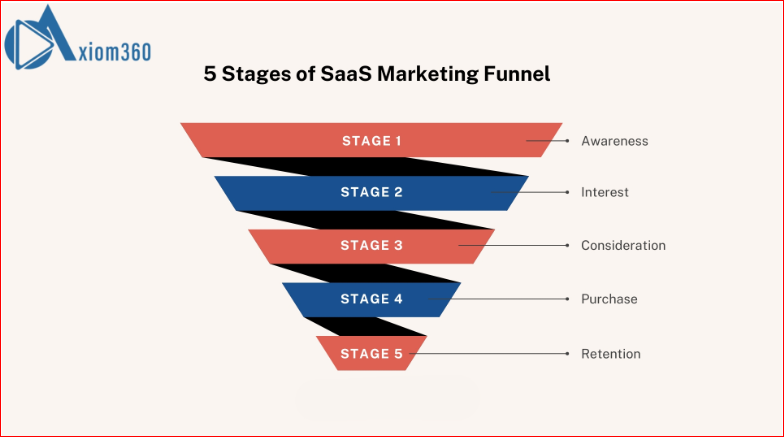
1. The Evaluation Stage Is Longer
SaaS buyers — especially in B2B — are cautious. They’re buying something their team will use every day, and switching costs are high. Your MOFU content needs to be particularly strong: deep comparison guides, detailed feature breakdowns, ROI calculators, and abundant social proof.
2. Free Trials Are the BOFU
In most SaaS funnels, the bottom-of-funnel conversion isn’t a sale — it’s a free trial or freemium sign-up. Your BOFU content needs to get people into the product, and then your post-onboarding content needs to convert free users into paying customers.
3. Churn Content Is Non-Negotiable
Post-purchase content — tutorials, update announcements, community, success stories — directly impacts whether customers stay or leave. In SaaS, this isn’t a nice-to-have; it’s core infrastructure.
4. Product-Led Content
One of the most powerful SaaS approaches is product-led content — writing “how to do X using [Product Name]” with screenshots and walkthroughs. This blends MOFU and BOFU beautifully and drives high-intent traffic.
Pro tip: Map your content to your user’s activation milestones. What does a user need to understand to reach their first “aha moment”? Build content that accelerates that moment, and you’ll see trial-to-paid conversion rates climb.
How to Build Your Content Marketing Funnel: Step-by-Step
Here’s the framework we use at Axiom360 when building funnels for clients across the UK and globally.
Step 1: Define Your Ideal Customer Profile (ICP)
Before you write a single word of content, get absolute clarity on who you’re writing for — not just demographics, but psychographics, job roles, pain points, goals, and objections. Your ICP shapes every decision downstream in the funnel.
Step 2: Map the Customer Journey
For each funnel stage, ask: What does my ICP know? What are they feeling? What questions are they asking? What would make them take the next step? This journey map becomes your editorial blueprint.
Step 3: Conduct Funnel-Layered Keyword Research
TOFU keywords are informational (“how to,” “what is”). MOFU keywords are comparative (“best X for Y,” “X vs Y”). BOFU keywords are transactional (“X pricing,” “hire X agency”). Build your keyword map across all three layers.
Step 4: Audit Your Existing Content
Map your existing content to funnel stages and identify gaps. Most businesses find that their MOFU is the weakest layer.
Step 5: Build Your Content Architecture
Design clear pathways from one stage to the next. Every TOFU piece should have a natural next step. Every MOFU piece should have a conversion-oriented CTA. Think in journeys, not isolated articles.
Step 6: Create and Distribute Strategically
Produce content at each stage, then distribute where your ICP spends their time — organic search for TOFU, email and LinkedIn for MOFU, retargeting ads for BOFU.
Step 7: Measure, Iterate, and Optimise
Set distinct KPIs for each funnel stage. Track organic traffic at the top, email sign-ups in the middle, and demos booked and revenue at the bottom. Review monthly. Kill what doesn’t work. Double down on what does.
Content Marketing Funnel Stages in 2026: What’s Changed
The content marketing funnel stages in 2026 look broadly familiar — but execution has shifted substantially. Here are the five most significant evolutions to account for.
1. The Zero-Click Search Reality
AI overviews and featured snippets now answer a huge percentage of informational queries before users visit a website. The goal isn’t just to rank — it’s to be the source Google cites, and to target queries that still drive meaningful click-through.
2. Dark Social and Invisible Attribution
More content consumption happens in places analytics can’t track: private Slack groups, WhatsApp conversations, forwarded emails, LinkedIn DMs. Your funnel is likely working harder than your data suggests.
3. AI-Assisted Personalisation
In 2026, smart content marketers use AI to serve different versions of MOFU content based on industry, company size, or behavioural signals. What was once reserved for enterprise teams is now accessible to any serious content operation.
4. Community as a Funnel Stage
Community — Slack groups, Discord servers, and active LinkedIn followings — has emerged as a powerful, self-reinforcing funnel layer. Community members are simultaneously at every funnel stage, creating demand and conversion at the same time.
5. The Collapse of TOFU and Brand
As AI commoditises generic informational content, pure TOFU content has become harder to differentiate on quality alone. The brands winning at the top in 2026 have distinctive POVs, genuine expertise, and strong brand voices. TOFU and brand-building are the same thing now.
Common Content Marketing Funnel Mistakes
Mistake 1: Only Building TOFU Content
Many businesses publish blog post after blog post, then wonder why traffic isn’t converting. The answer is almost always a missing middle. No MOFU content = no nurture = no conversions.
Mistake 2: Treating Every Blog Post as BOFU
If every piece of content ends with a hard “buy now” CTA, you’ll repel top-of-funnel visitors who aren’t ready to commit. Match your CTA to the funnel stage of the content — every time.
Mistake 3: No Clear Next Step
Every piece of funnel content should have one obvious, logical next step. If you haven’t decided what it is, neither has the reader — and they’ll leave.
Mistake 4: Ignoring Post-Purchase Content
The funnel doesn’t end at the sale. Neglecting existing customers in favour of constantly chasing new ones is a growth ceiling. Invest in post-purchase content and watch acquisition costs drop as referrals and retention improve.
Mistake 5: Measuring Everything the Same Way
Using conversion rate to evaluate a TOFU blog post is like judging a football team by how many goals their goalkeeper scored. Set stage-appropriate KPIs and measure accordingly.
How Axiom360 Builds Content Marketing Funnels That Convert
At Axiom360, we’ve been building content strategies and funnels for clients across the UK and internationally for years. We’re not a generic content mill — we’re a creative marketing agency that combines strategic thinking, SEO expertise, and genuine storytelling to build funnels that move real people to real action.
Our approach as a full-service Axiom360 UK agency starts with your customer, not your product. We map the complete journey — from the first Google search to the final conversion and beyond — then build a content architecture designed to compound over time.
Here’s what makes the Axiom360 creative marketing agency approach different:
- Funnel-first content strategy: We build a complete content architecture mapped to your specific buyer journey, with intentional pathways between every stage.
- SEO that works at every stage: From broad TOFU targeting to BOFU conversion page optimisation, our SEO strategy covers the entire funnel.
- Content that converts, not just ranks: Every piece of content is designed with a specific conversion goal in mind.
- Data-informed iteration: We track performance at every funnel stage and continuously optimise — doubling down on what works, retiring what doesn’t.
Whether you’re building a content funnel from scratch or improving an existing one, Axiom360 has the expertise and track record to help. Based in the UK, we work with ambitious brands who understand that content isn’t a cost — it’s an investment that compounds.
Ready to Build a Funnel That Actually Converts?
Axiom360 is a UK-based creative marketing agency specialising in content strategy, SEO, and full-funnel content systems for ambitious brands.
Talk to the Axiom360 Team → axiom360.co.uk/contacts/
Frequently Asked Questions
What is the difference between a sales funnel and a content marketing funnel?
A sales funnel focuses on the transactional path from lead to customer, often relying on direct outreach and paid tactics. A content marketing funnel uses valuable content to attract, educate, and nurture prospects through the same journey. The two are complementary, not competing.
How long does it take to see results from a content marketing funnel?
TOFU content typically takes 3–9 months to gain meaningful SEO traction. MOFU and BOFU content often produces quicker returns because it targets higher-intent audiences. Most businesses see first meaningful results within 6 months and significant ROI within 12–18 months.
Do I need a content marketing funnel if I’m a small business?
Absolutely — and arguably more so. Small businesses can’t sustain paid advertising indefinitely. A well-built content funnel creates compounding organic assets that generate leads for years. Start with one TOFU piece, one MOFU asset, and one BOFU conversion page and iterate from there.
What tools should I use to build a content marketing funnel?
For SEO: Ahrefs, SEMrush, or Surfer SEO. For email nurture: Mailchimp, ActiveCampaign, or HubSpot. For analytics: Google Analytics 4 and Hotjar. For CRM: HubSpot or Salesforce. What matters more than the tools is having a clear funnel strategy to underpin them.
Can I use AI to build a content marketing funnel in 2026?
Yes — and you should. AI accelerates content production, keyword research, and personalisation at scale. But AI-generated content without genuine expertise and a distinctive brand voice will struggle to cut through. Use AI as an accelerant, not a replacement for strategic thinking.
About the Author
Sehrish Javed is an SEO content writer and content strategist with 3+ years of experience in creating search-optimized, audience-focused content for digital brands. Her expertise spans various aspects of SEO, including AEO, GEO, schema optimization, and the integration of AI in content strategies. With hands-on experience in content management, she specializes in planning and executing content that aligns with search intent, drives visibility, and supports business growth. She actively keeps pace with evolving SEO trends and modern content strategies in the digital marketing space.
Feel free to connect with Sehrish on LinkedIn for more insights into SEO, content strategy, and AI-driven marketing trends.